
LLP Registration Services in Kanpur
Pvt Ltd, LLP, OPC Company Registration – Start Your Business in 7 Days
Get your company legally registered with MCA + PAN + TAN + GST + MSME + Current Bank A/C in one package. No hidden fees. 100% online process by ICAI CAs
Which Company Type Is Right For You?
| Type | Best For | Min Members | Liability | Compliance |
|---|---|---|---|---|
| Pvt Ltd Company | Startups, Funding, Scaling | 2 Directors, 2 Shareholders | Limited | High – Audit, ROC filing |
| LLP | Professionals, Agencies, Low compliance | 2 Partners | Limited | Medium – No audit <₹40L |
| OPC | Solo Founder, Freelancer | 1 Director, 1 Nominee | Limited | Medium – 1 ROC form |
| Partnership Firm | Small shop, Traditional business | 2 Partners | Unlimited | Low – Only ITR |
Documents Required –
For All Directors/Partners:
- PAN Card – Mandatory
- Aadhaar Card – For address + OTP
- Photo – Passport size
- Email + Mobile – Linked with Aadhaar
- Bank Statement – 2 months
For Registered Office:
- Electricity Bill – Not older than 2 months
- Rent Agreement + NOC if rented
- Property tax receipt if owned
Accounting & Bookkeeping
- Tally books, monthly P&L, Balance Sheet, GST reconciliation by experts.
What is an LLP?
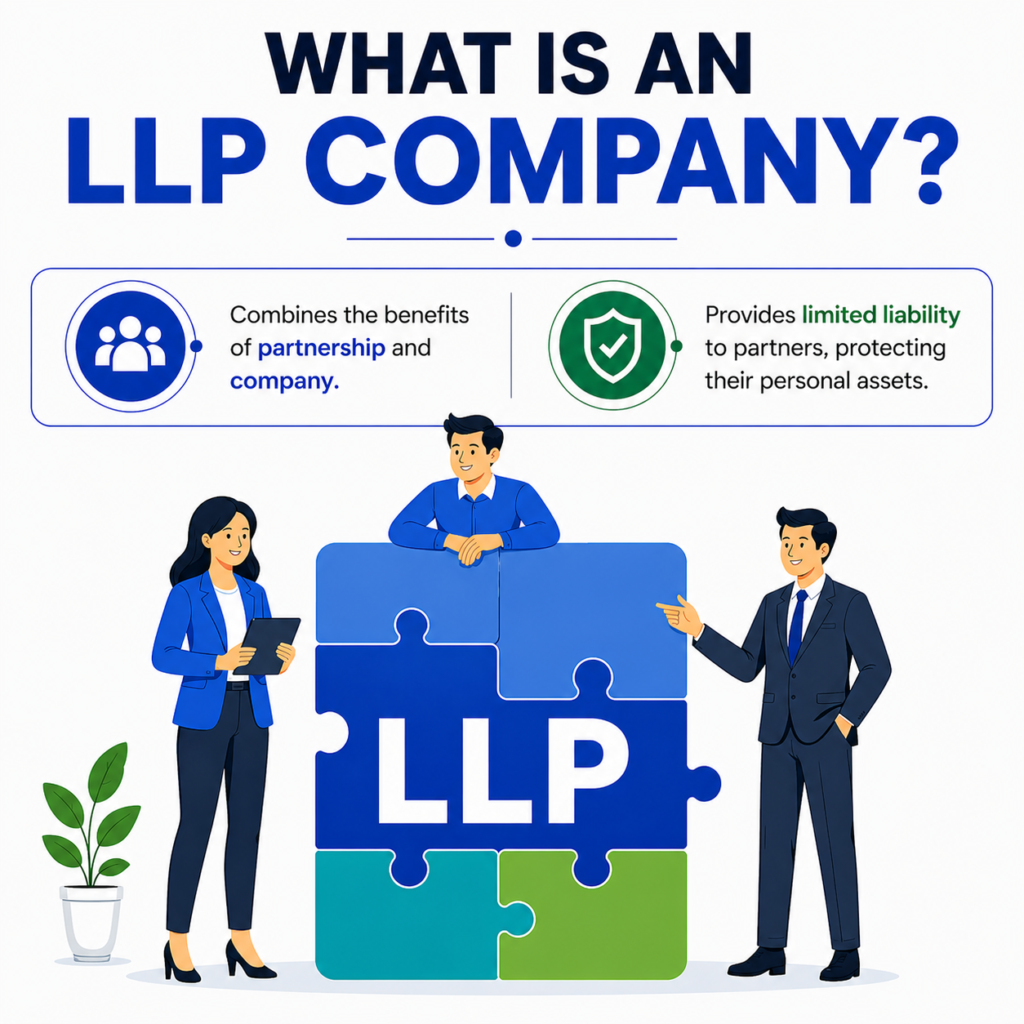
An LLP is a corporate business structure introduced under the Limited Liability Partnership Act, 2008 in India. It is a separate legal entity distinct from its partners, which means the LLP can own assets, incur debts, enter contracts, and sue or be sued in its own name. The key feature is limited liability – each partner’s personal assets are protected and their liability is restricted only to the amount they agreed to contribute to the LLP.
To form an LLP, a minimum of two partners is required and there is no maximum limit. Out of the partners, at least two must be “designated partners” and at least one designated partner must be a resident of India. There is no minimum capital requirement to start an LLP. The rights, duties, and profit-sharing between partners are governed by an LLP Agreement, which must be filed with the Ministry of Corporate Affairs – MCA – within 30 days of incorporation.
An LLP combines the operational flexibility of a traditional partnership with the limited liability benefit of a private limited company. For taxation, the LLP itself pays tax at 30% + surcharge/cess on profits, and the share of profit received by partners is exempt from tax in their hands. Compliance is lighter than a Pvt Ltd – audit is mandatory only if annual turnover exceeds ₹40 lakh or capital contribution exceeds ₹25 lakh.
Prerequisites and Eligibility Conditions for LLP Registration Process
Minimum Two Partners:
A Limited Liability Partnership requires at least two partners for incorporation. There is no maximum cap on the total number of partners.
Designated Partners Requirement:
Among the partners, minimum two must be appointed as designated partners, and both must be individuals. At least one designated partner should be a resident of India.
Representative for Corporate Partner:
If a body corporate becomes a partner in the LLP, it must nominate a natural person to act on its behalf as nominee.
Capital Contribution by Partners:
Every partner must contribute towards the capital of the LLP as mutually agreed in the LLP Agreement.
No Mandatory Minimum Capital:
There is no prescribed minimum authorized capital to form an LLP. Partners can decide the contribution amount.
Resident Designated Partner:
At least one of the designated partners must be a person resident in India to comply with LLP Act provisions.
Characteristics of Limited Liability Partnership (LLP)
Separate Legal Entity:
LLP has its own legal identity distinct from its partners. It can own assets, incur liabilities, sue and be sued in its own name.
Limited Liability:
Liability of each partner is limited to their agreed capital contribution. Personal assets of partners are protected from LLP debts.
Perpetual Succession:
LLP continues to exist irrespective of changes in partners due to death, insolvency, or resignation.
Minimum 2 Partners:
At least two partners required to form an LLP. No maximum limit on number of partners.
Designated Partners:
Minimum two designated partners required, of which at least one must be a resident of India.
No Minimum Capital:
There is no mandatory minimum capital contribution prescribed to incorporate an LLP.
Flexible Management:
Internal structure and profit sharing governed by LLP Agreement. Partners can manage the business directly.
Less Compliance:
Lower statutory compliance compared to a Private Limited Company. No requirement for board meetings or annual general meetings.
Audit Requirement:
Audit is mandatory only if annual turnover exceeds ₹40 lakh or capital contribution exceeds ₹25 lakh.
Transferability:
Ownership/partner’s interest can be transferred, but only as per provisions in LLP Agreement.
Taxation:
LLP is taxed as a partnership firm at 30% + surcharge/cess. Share of profit in hands of partners is tax exempt.
Governed by Law:
Registered and regulated under the Limited Liability Partnership Act, 2008 and Ministry of Corporate Affairs – MCA.
Advantages of Register LLP in India
Limited Liability Protection:
Personal assets of partners are safe. Partners are liable only up to their capital contribution in the LLP.
Separate Legal Entity:
LLP is distinct from its partners. It can own property, sign contracts, and sue or be sued in its own name.
Less Compliance vs Pvt Ltd:
No board meetings or AGMs required. Audit only if turnover > ₹40L or capital > ₹25L. Lower compliance cost and paperwork.
No Minimum Capital:
Can start with any amount. No mandatory minimum capital requirement to incorporate.
Tax Efficiency:
LLP pays 30% tax on profits. Share of profit given to partners is tax-free in their hands. No Dividend Distribution Tax.
Disadvantages of Register LLP in India
Not Suitable for Funding:
VCs and angel investors prefer Private Limited Companies. LLPs cannot issue equity shares, so raising funds is difficult.
Penalty for Non-Compliance:
Even with less compliance, late filing of annual returns/Form 8/Form 11 attracts ₹100 per day penalty with no maximum cap.
Higher Tax Rate than Companies:
LLP is taxed at flat 30% + surcharge/cess. No benefit of lower 22%/15% tax rates available to companies.
Limited Recognition Abroad:
Foreign companies and clients often prefer Pvt Ltd or Ltd companies over LLPs for contracts and partnerships.
All Partners’ Consent Needed:
Any major decision or change in LLP Agreement usually requires consent of all partners, which can slow down decision making.
Documents Required for LLP Registration Online
1. For Partners / Designated Partners
- PAN Card: Mandatory for all Indian partners.
- ID Proof: Aadhaar, Passport, Voter ID, or Driving License.
- Address Proof: Latest bank statement, electricity bill, mobile bill, or gas bill – not older than 2 months.
- Passport-size Photo: Recent colour photo on white background.
- DSC: Digital Signature Certificate for all designated partners.
- For NRI/Foreign Nationals: Passport notarized/apostilled + overseas address proof like bank statement/utility bill.
2. For Registered Office Address
- Utility Bill: Electricity bill, water bill, or gas bill – not older than 2 months.
- Ownership Proof: Sale deed/property tax receipt if owned.
- Rent Agreement + NOC: If rented, rent agreement + No Objection Certificate from owner.
3. Additional Documents
- LLP Agreement: Draft signed by all partners, to be filed within 30 days of incorporation.
- Consent to Act as Designated Partner: Form 9 from all designated partners. Subscribers’ Sheet: Signed by all partners with details of capital contribution.
Hassle-Free LLP Registration, Reimagined by Lawgical Barrister
At Lawgical Barrister, we turn LLP incorporation from paperwork chaos into a clean, end-to-end digital experience. Here’s what you get:
Legal-First Approach:
Founded by legal professionals, not just form-fillers. Every step is vetted for compliance so your LLP starts on solid legal ground, not just registered fast.
Name Strategy & Approval:
We don’t just check name availability. We strategize it — ensuring your LLP name is unique, brandable, MCA-compliant, and trademark-safe.
DSC + DPIN in 24 Hours:
Quick processing of Digital Signature Certificates and DPIN for designated partners. No chasing vendors, no delays.
Custom LLP Agreement:
No generic templates. We draft your LLP Agreement around your profit-sharing, roles, exit clauses, and dispute terms — airtight and MCA-ready.
Zero-Error Filing:
FiLLiP, Form 9, PAN, TAN — we handle every MCA filing with precision. You get a single dashboard with real-time status, not confusing emails.
Transparent Pricing:
One flat fee. No hidden MCA charges, no last-minute “add-ons.” Includes name approval, government fees, PAN, TAN, and draft agreement.
Dedicated Legal Manager:
One point of contact who actually understands LLPs. Ask us anything — compliance, tax, FDI rules — and get answers, not ticket numbers.
Post-Incorporation Toolkit:
Get your COI, PAN, TAN, LLP Agreement, plus compliance calendar for Form 11, Form 8, and IT filings. So you stay compliant long after registration.
Table of Contents
Toggle