
TDS Return Filing
Reliable TDS Return Filing for Your Business
TDS Return Filing service in Kanpur
Tax Deducted at Source means withholding tax from income at the time of payment. Any person or entity that deducts TDS is required by law to file quarterly TDS returns before the due date, providing complete details of all deductions made. Managing TDS payments and online return filing can be complicated, and professional support helps make the process accurate, compliant, and on time.
Get Your TDS Returns Filed Easily – Expert Help for Timely and Correct Compliance
TDS – Tax Deducted at Source
TDS is a system where the payer deducts tax while making specific payments to the payee. Tax is deducted during transactions like salary, rent, interest, professional fees, and commission. Usually the recipient pays income tax, but under TDS the deductor must deposit the tax online with the government. This ensures tax is collected in advance from the payment itself.
The amount received after TDS is the payee’s net income, and they must report the gross amount in their tax return. After depositing TDS, filing the TDS return online is mandatory as per tax rules.
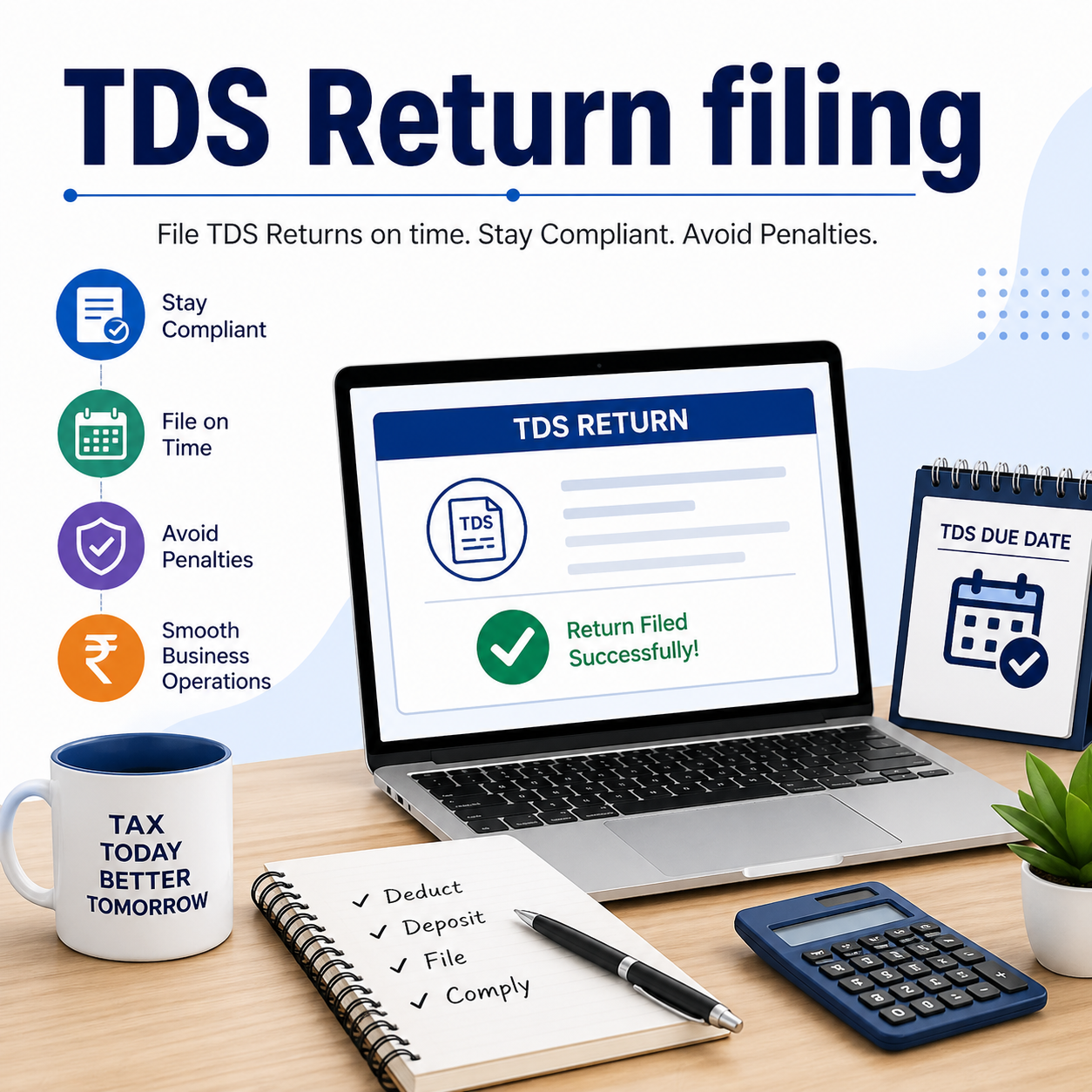
Who Should Deduct TDS
Individuals, HUFs, firms, companies, and other entities liable to deduct TDS under the Income Tax Act, 1961. Applicability depends on turnover and specific conditions. Such persons must complete the TDS apply process and get registered as a TDS deductor.
Deposit of TDS
Deposit of TDS means remitting the deducted TDS amount to the government within the prescribed due date. Persons who have completed TDS apply and registration must ensure timely deposits to stay compliant and avoid penalties. After depositing, TDS filing must be completed online to avoid penalties and legal issues.
TDS Due Date
Generally by the 7th of the following month.
For TDS deducted in March: by April 30 for most deductors, or by March 31 for certain government deductors.
Common Payments Attracting TDS
Salaries, rent, contractor/sub-contractor fees, professional fees, commission, interest other than interest on securities, etc.
TDS Thresholds
Comply with TDS rules if any of the following apply. Thresholds may change, so verify with current provisions:
| Section | Payment Type | Threshold |
|---|---|---|
| Sec 194I | Rent | TDS if annual rent exceeds ₹2,40,000 |
| Sec 194C | Contractor/Sub-Contractor | TDS if single payment > ₹30,000 or total in FY > ₹1,00,000 |
| Sec 194J | Professional Fees | TDS if annual payment exceeds ₹30,000 |
| Sec 194A | Interest | TDS if annual interest > ₹40,000, ₹50,000 for senior citizens |
| Sec 192 | Salary | TDS if employee’s total taxable salary exceeds basic exemption limit |
Who is Required to File a TDS Return?
1. Basic Rule
Any person who has deducted TDS during a quarter is legally required to file a quarterly TDS return for that period u/s 200(3) of Income Tax Act, 1961.
2. Mandatory TAN Holders
You can deduct TDS only if you have a TAN. Once you have TAN and make a TDS deduction, return filing becomes compulsory. TAN is not required for TDS on property u/s 194IA or rent by individual/HUF u/s 194IB/194M – those use Form 26QB/26QC instead.
3. Companies & Corporates
All companies including Private Limited, One Person Company, Public Limited, and PSUs must deduct TDS on applicable payments. If any TDS is deducted in a quarter, they must file the return even if amount is small.
4. LLPs & Partnership Firms
Liable to deduct TDS on salary, rent, contractor, professional fees etc. as per relevant sections. If deduction is made, quarterly return in Form 24Q/26Q is mandatory.
5. Individuals & HUFs
Required to deduct TDS only if they were subject to tax audit u/s 44AB in the immediately preceding financial year.
Business: Turnover > ₹1 Crore in previous FY
Profession: Gross receipts > ₹50 Lakh in previous FYIf covered, they must deduct TDS and file returns. If not under tax audit, they are generally not required to deduct TDS, except for TDS on rent >₹50K/month u/s 194IB or payment to contractor/professional >₹50L/year u/s 194M.
6. Government Deductors
Central Government, State Government, local authorities, and government offices must file TDS returns if they deduct tax. They use Form 24G for book entry payments.
7. Trusts, AOP, BOI, AJP
If they make specified payments attracting TDS, they must obtain TAN, deduct tax, and file quarterly returns.
8. When Filing is Not Mandatory
If no TDS was deducted in the entire quarter, filing NIL return is optional. Non-filing of NIL return does not attract penalty.
If you only deduct TDS on property or rent as individual/HUF under 194IA/194IB/194M, you file Form 26QB/26QC/26QD, not quarterly TDS return.
9. Forms Based on Nature of Deduction
| Form | Used For |
|---|---|
| 24Q | TDS on Salary u/s 192 |
| 26Q | TDS on all non-salary payments to residents |
| 27Q | TDS on payments to non-residents |
| 27EQ | TCS – Tax Collected at Source |
TDS Return Filing Due Dates
Timely filing of TDS returns each quarter is required to stay compliant with Income Tax rules. The due dates for submitting quarterly TDS returns are:
| Quarter | Months Covered | Last Date to File |
|---|---|---|
| Q1 | April – June | 31st July |
| Q2 | July – September | 31st October |
| Q3 | October – December | 31st January |
| Q4 | January – March | 31st May |
Why is TDS Return Filing Essential?
Legal Compliance
Filing TDS returns quarterly is mandatory u/s 200(3) of Income Tax Act. Non-filing leads to late fees u/s 234E and penalty u/s 271H.
Tax Credit to Deductee
Return filing updates Form 26AS/AIS of the payee. Only after this can the deductee claim TDS credit while filing their Income Tax Return.
Avoid Penalties & Interest
Timely filing prevents ₹200 per day late fee and penalties up to ₹1,00,000. It also avoids interest on late deposit of TDS.
Issuing TDS Certificates
You can generate Form 16/16A for deductees only after filing the return. These certificates are proof of tax deducted for the payee.
Accurate Government Records
TDS returns help the Income Tax Department track tax collection, match income reported by deductors and deductees, and reduce tax evasion.
Documents Required for TDS Return Submission
TAN Details
Valid Tax Deduction Account Number certificate. Required for every return.
PAN Details
PAN of deductor and PAN of all deductees. Wrong PAN leads to higher TDS rate u/s 206AA.
Challan Details
Challan 281 details for TDS deposited – BSR code, challan serial number, date of deposit, and amount.
Deductee Information
Name, address, payment amount, date of payment, TDS deducted, rate of deduction, and nature of payment for each deductee.
Form 27A
Summary of the TDS return. Auto-generated during return filing but signed by deductor.
Digital Signature / EVC
DSC of authorized person or Aadhaar-based EVC for online submission.
Salary Records – For Form 24Q
Employee details, breakup of salary, exemptions u/s 10, deductions under Chapter VI-A, tax computation.
Lower/NIL Deduction Certificate
Copy of certificate u/s 197 if TDS deducted at lower rate for any deductee.
Previous Quarter Returns
To carry forward and match cumulative figures if needed.
Why Choose Lawgical Barrister for Your TDS Return Filing?
With Lawgical Barrister, you get precise legal and tax expertise for every TDS compliance step. Our qualified professionals simplify complex provisions of the Income Tax Act, ensuring your TDS deductions, deposits, and returns are handled without error.
We stay current with every CBDT update and notification, so your filings meet the latest legal standards and you avoid late fees, interest, or penalties u/s 234E and 271H. From accurate TDS computation to form preparation, challan verification, and return submission, we manage the entire process with legal diligence.
Whether you are a company, firm, or individual deductor, our end-to-end support gives you clarity, accuracy, and peace of mind.

Table of Contents
Toggle