
One Person Company (OPC)
Expert Services for One Person Company (OPC) Registration
Register Your One Person Company (OPC) Online – Simple, Quick, Compliant
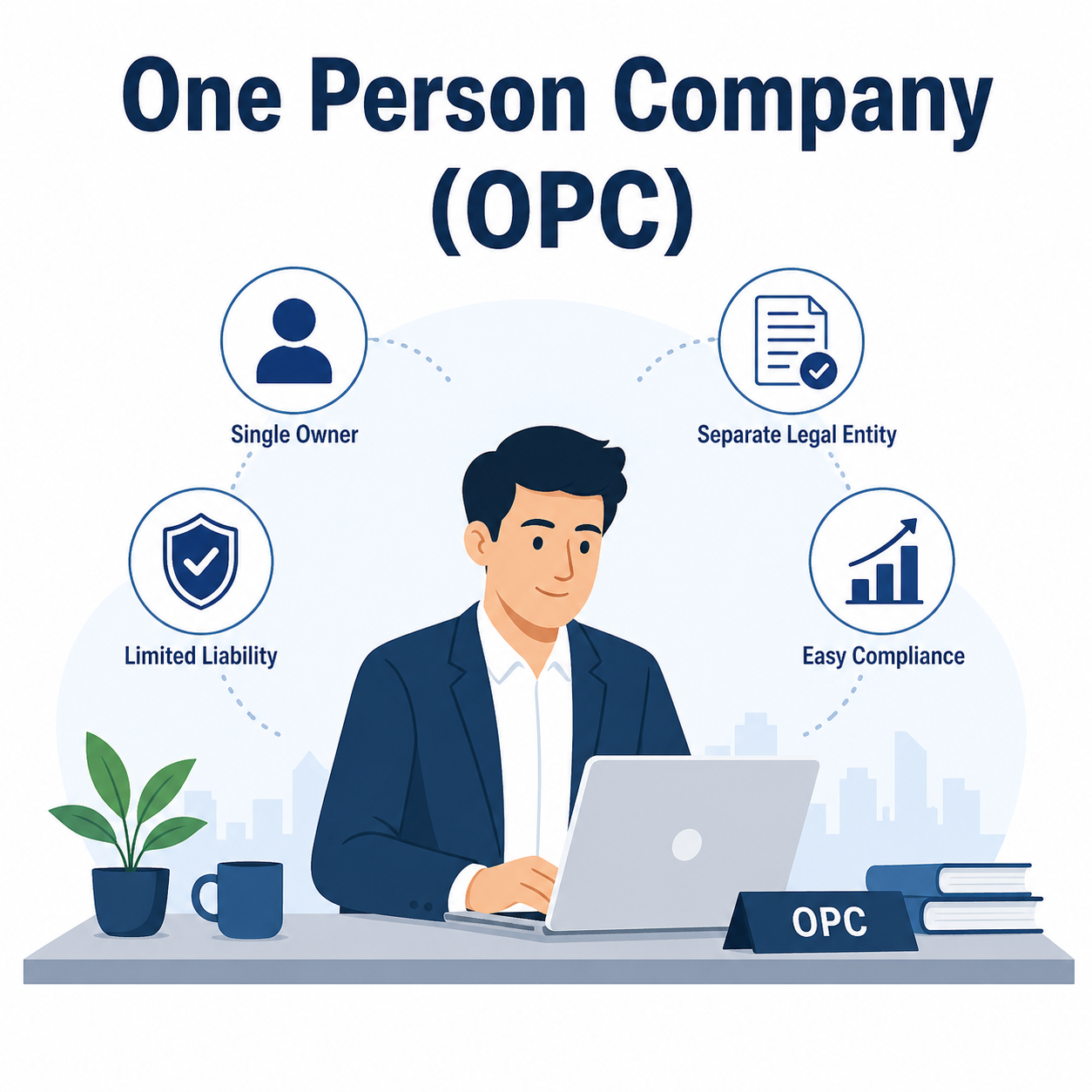
One Person Company is the smartest structure for solo founders who want the power of a private limited company without needing a co-founder. OPC gives you limited liability, corporate status, and 100% control — all in one.
In an OPC, you are the sole shareholder and director. You get the credibility of a company with the simplicity of running solo. It combines the best of a proprietorship and a private limited company, with legal protection for your personal assets.
At Lawgical Barrister, we make OPC incorporation 100% online and hassle-free. Our CA + CS team handles everything from name approval to Certificate of Incorporation, so you can focus on business, not paperwork. Transparent process, expert drafting, and end-to-end compliance — that’s how we register your OPC.
What is a One Person Company (OPC)?
Introduced under the Companies Act, 2013, OPC was designed to promote solo entrepreneurship and bring MSMEs into the formal economy. It allows a single Indian citizen and resident to form a company with limited liability.
As per Section 2(62) of the Companies Act, 2013, an OPC can have only one member and one director — and both roles can be held by the same person. You must also appoint a nominee who will take over if needed.
Eligibility Criteria to Register One Person Company (OPC)
Before starting the OPC registration, check if you meet these conditions under the Companies Act, 2013 and Companies (Incorporation) 2nd Amendment Rules, 2021:
1. Who Can Incorporate
Only a Natural Person who is an Indian Citizen can form an OPC.
NRIs are allowed if they meet the residency rule.
Resident in India means: Stayed in India for at least 120 days during the immediately preceding financial year. Earlier it was 182 days.
2. Authorized Capital
Minimum Authorized Capital: ₹1,00,000 is required at the time of incorporation. This is mentioned in the Capital Clause of MOA.
There is no minimum paid-up capital requirement now.
3. Nominee Requirement
You must appoint one nominee while filing incorporation forms.
If the member dies or becomes incapacitated, the nominee becomes the member of the OPC.
4. Business Activity Restrictions
OPC cannot carry on financial activities like banking, insurance, investment in securities, chit funds, or NBFC activities.
All other lawful businesses like manufacturing, trading, services, consultancy are allowed.
The nominee must also be: Indian citizen, natural person, 18+ years, and meet the 120-day residency rule.
5. Conversion Rules – Updated
Mandatory conversion rule removed w.e.f 1 April 2021.
Earlier: If paid-up capital exceeded ₹50 lakh OR average turnover crossed ₹2 Cr for 3 years, conversion to Pvt Ltd was compulsory.
Now: No threshold. OPC can continue voluntarily. Conversion to Pvt Ltd or Public Ltd is optional.
Advantages of One Person Company (OPC)
1. Limited Liability Protection
The owner’s personal assets are protected. If the company faces losses or debt, your personal savings, house, or car cannot be used to pay business liabilities. Risk is limited to the capital invested.
2. Separate Legal Entity Status
OPC has its own legal identity distinct from the owner. It can own property, open bank accounts, enter contracts, and sue or be sued in its own name. This creates a professional image.
3. Complete Control with Single Ownership
One person holds 100% ownership and decision-making power. No need for partner approval or board resolutions. This allows faster decisions and eliminates conflicts.
4. Higher Credibility than Sole Proprietorship
The “(OPC) Private Limited” tag improves trust with banks, vendors, and customers. It’s easier to get loans, corporate contracts, and government tenders compared to a proprietorship.
5. Lower Compliance than Private Limited Company
OPCs have fewer compliance requirements. No need to hold AGMs or board meetings. Cash flow statement is not mandatory. Overall paperwork and compliance cost is less than a Pvt Ltd company.
Disadvantages of One Person Company
Single Ownership Restriction
Only one person can be a member. You cannot add a partner or co-founder directly. If you want to bring in investors or share ownership later, you must convert to a Pvt Ltd or LLP.
Not Suitable for High-Growth Businesses
Banks and VCs usually avoid funding OPCs because equity cannot be issued easily. Raising capital through investors is difficult. Tax benefits for startups are also limited compared to Pvt Ltd.
Restrictions on Business Activities
OPC cannot do banking, insurance, investment, or NBFC activities. Also, an OPC cannot be incorporated or converted into a Section 8 company for charitable work.
Mandatory Nominee Dependency
You must appoint a nominee during incorporation. If the nominee withdraws consent and you don’t appoint a new one within 15 days, the OPC can face compliance issues. Your business continuity depends on that one person.
Taxation at Flat Corporate Rate
OPC is taxed at 25%/30% flat corporate tax rate + cess. No slab benefit like individuals. Also, dividend distribution tax is not there, but overall tax outgo can be higher than proprietorship for small profits.
Required Documents for OPC Registration
1. Documents of Member/Director & Nominee
- PAN Card – Self-attested copy. Mandatory for member, director, and nominee
- Aadhaar Card – Self-attested copy for ID + address proof
- Identity Proof – Passport / Voter ID / Driving License – any one, self-attested
- Address Proof – Bank Statement / Electricity Bill / Mobile Bill – not older than 2 months, self-attested
- Passport-size Photo – Recent colour photo with white background
- Email ID & Mobile Number – For DSC application and OTP verification
2. Documents for Registered Office Address
- Utility Bill – Electricity / Water / Gas bill of office address. Not older than 2 months
- NOC from Owner – No Objection Certificate if premises is rented, on plain paper
- Rent Agreement – If office is on rent. Notarized copy preferred
- Sale Deed / Property Papers – If office is owned by director/member
3. Digital Requirements & Forms
- DSC – Digital Signature Certificate – Class 3 DSC for member and director
- DIN – Director Identification Number – Applied automatically through SPICe+ if not already allotted
- INC-3 – Consent of Nominee, signed by nominee with PAN + Aadhaar attached
- DIR-2 – Consent to Act as Director, signed by director
- INC-9 – Declaration by member and director regarding non-conviction, etc.
- MOA & AOA – Memorandum and Articles of Association, auto-generated in SPICe+
Table of Contents
Toggle